
The only part of Hanoi that usually treats foreigners as living organisms, not walking ATMs. The suffering just has better lighting.
CHAOSCB EDITORIAL RANKING
Where To Live In Hanoi If You Want To Suffer Less
Hanoi neighbourhoods ranked by comfort, chaos, cost, and emotional damage, from Tay Ho to Minh Khai.
Tay Ho wins. Minh Khai loses. And if you can choose Da Nang instead, you probably should.
This is not a tourist list and not a laboratory table. It is a ChaosCB field report for foreigners spending real money in Hanoi and expecting actual quality of life in return.
THE 20-SECOND ANSWER
If you are already forced to live in Hanoi, where will you suffer less?
Hanoi has a special talent: it can charge you premium money and still hand you fumes, horns, dust, and civic fatigue before breakfast. Some cities are crowded. Hanoi often feels personally crowded. So this is not a list of "amazing" districts. It is a survival map. And if work, family, love, or school logistics have not already trapped you in the capital, the honest answer is to choose Da Nang and send Hanoi a postcard.
Premium money, discount living standard. Expensive enough to insult you, chaotic enough to finish the job.
QUICK RANKING
Read this first. Argue later.
The fast version, for people choosing a base before the city chooses their blood pressure.
- 01Tay Ho
Suffer less. Best overall for most foreigners who can afford it.
- 02Ba Dinh
The adult choice. Central access without full Old Quarter chaos.
- 03Hoan Kiem
Great for short stays, questionable for sanity.
- 04Cau Giay
Functional suffering. Good if work or school is there.
- 05Long Bien
More space, then a bridge becomes your personality.
- 06Ha Dong
Cheaper suffering with a distance tax paid in commute.
- 07Hai Ba Trung / Minh Khai
Premium suffering. The worst deal on this page.
English-friendly services and a community that has also argued with a landlord.
Less chaos per square metre, more services that speak your language.
Honest transaction: density and traffic in exchange for function.
A beautiful movie you do not have to pay rent to live inside.
First-world expectations indoors. The 1980s with a motorbike loan outside.

THE LENS
This is an expat quality-of-life ranking, not a tourist guide.
This is not for people whose idea of quality of life is one plastic stool, two beers, and a dramatic caption about authentic Asia. It is for foreigners spending real money and expecting relief in return. We judge districts by air and pollution, traffic pain, noise, cleanliness, walkability, English friendliness, expat community, housing quality for the money, and whether the public environment outside matches the price you paid inside.
One disclaimer that matters: this is not about whether locals can make it work. Vietnamese people can survive almost anything. That does not make the environment good. It just means the survival software is already installed. Foreigners usually arrive without it.
THE RANKING
The full ranking, for this specific kind of person.
A practical ordering, not a lab table. The point is not that everyone must agree with every slot. The point is that for foreigners spending serious money and expecting real quality of life, the tradeoffs between these districts are not remotely equal.
01
Tay Ho
Suffer less.
Best for: newcomers, families, remote workers, anyone who values cafes, gyms, food, and sanity.
Biggest problems: still construction, still traffic, sometimes absurd prices and lake-adjacent rent without lake-adjacent quality control.
Avoid if: you need to be deep in the old centre daily, or you hate expat bubbles.
The part of Hanoi where the suffering has better lighting.
02
Ba Dinh
The adult choice.
Best for: people who need Hanoi to function rather than charm them.
Biggest problems: ugly traffic in places, high prices, some dense and not especially peaceful pockets.
Avoid if: you want romance more than structure.
Ba Dinh is where Hanoi puts on a shirt with buttons.
03
Hoan Kiem
Great to visit, dangerous to romanticise.
Best for: short stays, walkable pockets, people who want Hanoi as a movie.
Biggest problems: dense, noisy, messy, expensive for what you get; charm often means old plumbing with personality.
Avoid if: your nervous system needs an off switch.
Something is always happening. That is exactly the problem.
04
Cau Giay
Practical, functional, spiritually grey.
Best for: people whose work, office, or child's school already points here.
Biggest problems: busy roads, real density, an atmosphere that gets things done then makes you tired.
Avoid if: an agent said "very convenient" and nothing else. That phrase has ruined lives.
Very Hanoi, in a corporate shirt.
05
Long Bien
More space, more compromise.
Best for: families and anyone wanting larger homes and breathing room.
Biggest problems: the river. Crossing back into central Hanoi turns simple plans into logistical theatre.
Avoid if: you need strong expat services and central access daily.
More room to breathe, then a bridge every time you want a life.
06
Ha Dong
Cheaper suffering with a distance tax.
Best for: people whose work, school, or family is genuinely already out there.
Biggest problems: distance. Hanoi traffic turns "only 30 minutes" into a daily ritual of fumes, horns, and silent regret.
Avoid if: your real life is elsewhere and you are only buying the discount.
Far enough for Hanoi to charge you in time, patience, and petrol-flavoured sadness.
07
Hai Ba Trung / Minh Khai
Premium suffering. The worst deal here.
Best for: almost no one choosing freely on quality of life.
Biggest problems: serious money meets noise, dust, traffic, and a permanently overstimulated street.
Avoid if: you expect the public environment to rise to match the price.
Expensive enough to insult you. Chaotic enough to finish the job.
#1 TAY HO
The least punishing version of Hanoi
Tay Ho wins because it is the only part of Hanoi that often feels like it understands foreigners exist as living organisms, not just walking ATMs with passport problems. It has the expat infrastructure: cafes, gyms, restaurants, international food, English-speaking services, lake access, wider breathing room, and a community of people who also look like they have argued with a landlord before.
Is it perfect? No. There is still construction, still traffic, still roads that look like they were designed during a group argument. Some prices are absurd. Some landlords have watched too many videos about "foreign tenant equals luxury yield." But compared with the rest of Hanoi, Tay Ho gives you the highest chance of waking up and not immediately regretting your address.
The important difference is emotional. In many Hanoi districts, the street attacks you the moment you step outside. In Tay Ho, at least some streets let you breathe before the city starts negotiating with your nervous system.
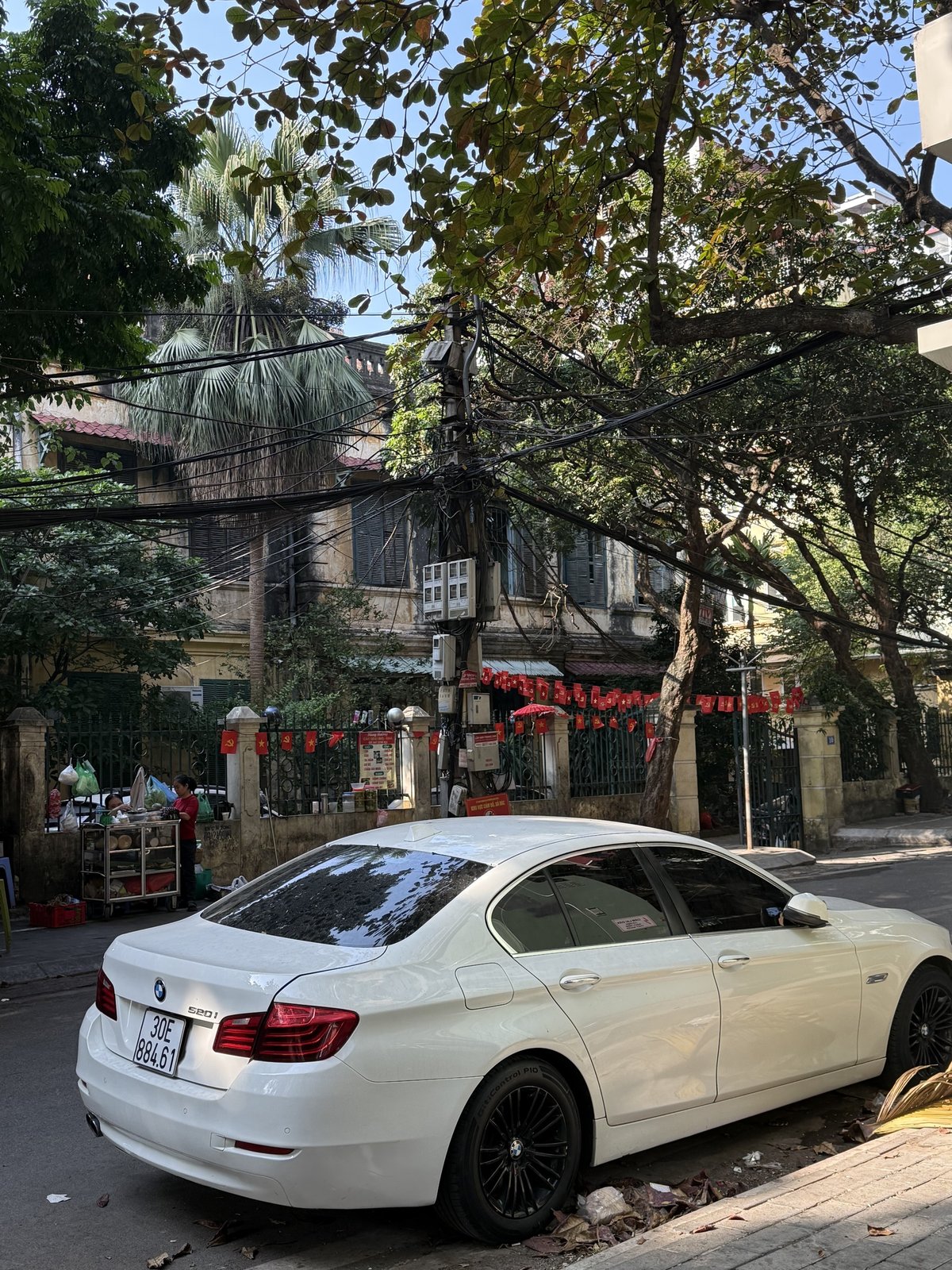 Hanoi, up close
Wires, walls, and the street that comes with the rent.
Hanoi, up close
Wires, walls, and the street that comes with the rent.
WHY TAY HO WINS
Tay Ho is not heaven. It is just where the suffering has better lighting.
It does not need to outperform Singapore. It only needs to stop antagonising your lungs, your commute, your ears, and your patience every time you open the door. Most of Hanoi cannot clear that bar. Tay Ho usually can.
THE MIDDLE OF THE TABLE
Ba Dinh, Hoan Kiem, Cau Giay, Long Bien, Ha Dong.
Ba Dinh is not the funniest district, which is probably why it is more livable. Embassies, offices, decent apartments, real structure, and enough central access to feel connected without living inside the tourist blender. Romance is overrated when your Grab driver has been stuck for 27 minutes and moved 300 metres.
Hoan Kiem is the Hanoi people imagine before Hanoi happens to them: the lake, the Old Quarter, the cafes, the feeling that something is always happening. Something is always happening. For a tourist it is perfect; for long-term life it depends how much stimulation your soul can survive. It does keep one rare Hanoi asset: actual walkability in certain pockets. In a city where walking sometimes feels like applying for death, that earns points.
Cau Giay is not bad, just very Hanoi in a corporate shirt: offices, schools, newer buildings, Korean and Japanese pockets, enough infrastructure to be useful. It rarely feels relaxing, but it offers a clear transaction: accept traffic and density in exchange for function. Do not move there because an agent said "very convenient."
Long Bien gives you space and newer developments, then the bridge enters the chat. It can work if your life is arranged around it; if not, the river becomes part of your daily mood. Ha Dong is often sold as value, and the discount is real, but it comes with terms and conditions, and the biggest cost is distance. What looks like "only 30 minutes" in a property pitch becomes a daily ritual of fumes, horns, and silent regret.
Hai Ba Trung / Minh Khai
High spend. Low relief.
#7 HAI BA TRUNG / MINH KHAI
The worst deal in this ranking
Hai Ba Trung, especially around Minh Khai, is the worst place in this ranking for the foreigner quality-of-life lens. Not because every street is equally bad. Not because nobody should ever live there. Because the deal is bad: premium money, discount living standard.
Around Minh Khai, you can spend serious money and still step outside into noise, pollution, traffic, dirt, shouting, construction, trucks, bikes, horns, blocked pavements, and a public environment that feels permanently overstimulated. It is expensive enough to sell you prestige, but chaotic enough to make you wonder where the prestige is hiding. Inside the apartment you may be building first-world expectations. Outside, the street can feel like the 1980s got a motorbike loan. That gap is what makes it so painful.
If an area is cheap and rough, at least the transaction is honest. Minh Khai is not that simple. Real estate, land, and build-up can all be expensive. You may put full-cash, serious-life-commitment money into a place, then open your door and receive fumes, traffic, garbage, civic fatigue, and noise that feels engineered by a committee of enemies. That is not local colour. That is a bad quality-of-life trade.
WHY IT FEELS WORSE THAN NORMAL CHAOS
Crowded without being charming. Expensive without feeling premium.
Hanoi is noisy in many places, but some areas give you a reason to tolerate it: walkability, services, English, expat support, better air, better cafes. Minh Khai gives too little of that compensation. Busy without being convenient. Central-ish without feeling accessible. Local without feeling peaceful. You get the price of ambition and the street life of punishment. Friendly people exist here, of course. But friendly is not the same as considerate, and a smile does not lower the horns, dust, or scooters arriving from five directions like unpaid actors in a disaster film.
THE CONFESSION
Some of us did not misread Vietnam. We overcommitted to Hanoi.
Sometimes you choose the wrong district for the most human reasons: love, family gravity, school logistics, "easy access to town," and the fantasy that traffic will behave because the map looks short. Then reality arrives. The road is jammed. The horns start early. The noise keeps going. The air is tired. The pavement is theoretical. And the city reminds you that distance on Google Maps is not the same as distance in Hanoi.
You can sink serious, life-commitment money into land and build-up, then still step outside into a street that gives you none of the emotional return you thought money was supposed to buy. That is why this area ranks last. Not because it is the cheapest. Because it may be the most insulting.
WHY TAY HO WINS AND MINH KHAI LOSES
It comes down to one word: buffer.
Tay Ho wins because it gives foreigners a buffer. Not perfection. A buffer. A place to breathe, to find English, where food, coffee, gyms, services, and community reduce the daily decoding. The city still annoys you, but it does not always feel like it is doing it personally.
Minh Khai loses because it offers too little buffer for the money. If you pay cheap rent, fine, you knew the deal. But if you are spending serious money, buying land, building a house, paying legal fees, and trying to create first-world housing in a public environment that still hands you horns, dust, traffic, and garbage at the door, the deal becomes absurd. The house may be premium. The street still sends you an invoice for emotional damage.
FINAL RANKING
Best to worst, for expats spending real money.
- Best overall: Tay Ho
- Best practical central option: Ba Dinh
- Best short-stay central option: Hoan Kiem
- Best if work or school forces you there: Cau Giay
- Best if you want space and can handle distance: Long Bien
- Best if budget matters and your life is already there: Ha Dong
- Worst premium-money deal: Hai Ba Trung, especially Minh Khai
Hanoi is not unlivable. That is the trick. It is livable enough to keep you there, painful enough to make you complain, and expensive enough in the wrong district to make you feel personally scammed by geography. The apartment is only half the product. The street outside is the other half. And in Hanoi, the street often wins. Choose carefully.
FAQ
Fast answers before you sign the wrong lease.
What is the best district in Hanoi for expats?
Tay Ho, for most foreigners who can afford it: the most expat infrastructure, lake-side breathing room, English-friendly services, and the highest chance of stepping outside without immediately regretting your address.
What is the worst district in Hanoi for expats spending real money?
Hai Ba Trung, especially around Minh Khai. It is expensive enough to sell you prestige but chaotic enough to take it back at the front door: noise, traffic, dust, and weak expat comfort for serious money.
Is Tay Ho worth the higher rent?
For most foreigners, yes. It is not cheap and not perfect, but it buys a buffer: cafes, gyms, international food, English services, and streets that let you breathe before the city starts negotiating with your nervous system.
Should I live in Hanoi or Da Nang?
If you have a free choice and want easier daily quality of life, Da Nang usually wins. This ranking is for people already stuck choosing inside Hanoi for work, family, or school. If you are stuck in Hanoi, choose Tay Ho or Ba Dinh.
SOURCE NOTE
A field report, not a stats table.
District-level quality-of-life data barely exists in clean form, so this ranking is lived-experience ordering, not a laboratory table, and it deliberately invents no per-district numbers. The backdrop is real, though: Hanoi's city-level indicators for air and traffic are among the worst in Vietnam, which is why the same complaints keep repeating no matter which district you pick. For the city-level numbers behind that picture, see the ChaosCB Vietnam city ranking.
KEEP GOING
This is the Hanoi sequel to the citywide ranking.
If you have not chosen a city yet, start one level up. If Hanoi is already decided, the reports explain why the same patterns keep repeating: traffic, property, paperwork, and the expensive comedy of assuming money fixes a city.